What Is Product Schema Markup?
Product Schema is the practice of optimizing online store pages and architecture to rank higher in search results and drive more organic traffic to product and category pages. It combines traditional SEO principles with ecommerce-specific techniques. For background context, see the reference at Schema.org.
For online retailers, organic search is typically the largest traffic channel, driving 30-40% of all visits. Product Schema ensures your products appear when shoppers are actively searching with purchase intent, making it one of the highest-ROI marketing channels for ecommerce businesses.
The ecommerce SEO landscape presents unique challenges: large product catalogs, dynamic inventory, faceted navigation, duplicate content from product variations, and intense competition from marketplace giants like Amazon. A solid product schema strategy addresses each of these challenges systematically.
Key Takeaway
Product Schema directly impacts your bottom line by connecting your products with shoppers who are ready to buy. Unlike paid advertising, the traffic from organic search comes with zero cost-per-click, making it increasingly valuable over time.
Why Product Schema Markup Matters
Understanding why product schema matters requires looking at the broader search landscape. Search engines process billions of queries daily, and the competition for organic visibility intensifies every year. Without a focused approach to product schema, businesses struggle to maintain or improve their search positions.
Further reading: Schema.org Product reference.
The data makes the case clearly: the top 3 organic search results capture over 60% of all clicks for any given query. Pages ranking on page 2 receive less than 2% of total clicks. For businesses investing in product schema, the difference between ranking on page 1 versus page 2 often means the difference between profitability and obscurity.
Beyond traffic, product schema drives qualified leads and conversions. Organic search visitors typically convert at 2-4x the rate of social media traffic because they are actively searching with intent. By aligning your product schema strategy with user intent, you attract visitors who are already interested in what you offer.
Pro Tip
Focus your product schema efforts on keywords where you can realistically rank within 3-6 months. Use Rank Crown's Keyword Difficulty metric to identify these opportunities. Starting with lower-competition terms builds momentum and authority for tackling harder keywords later.
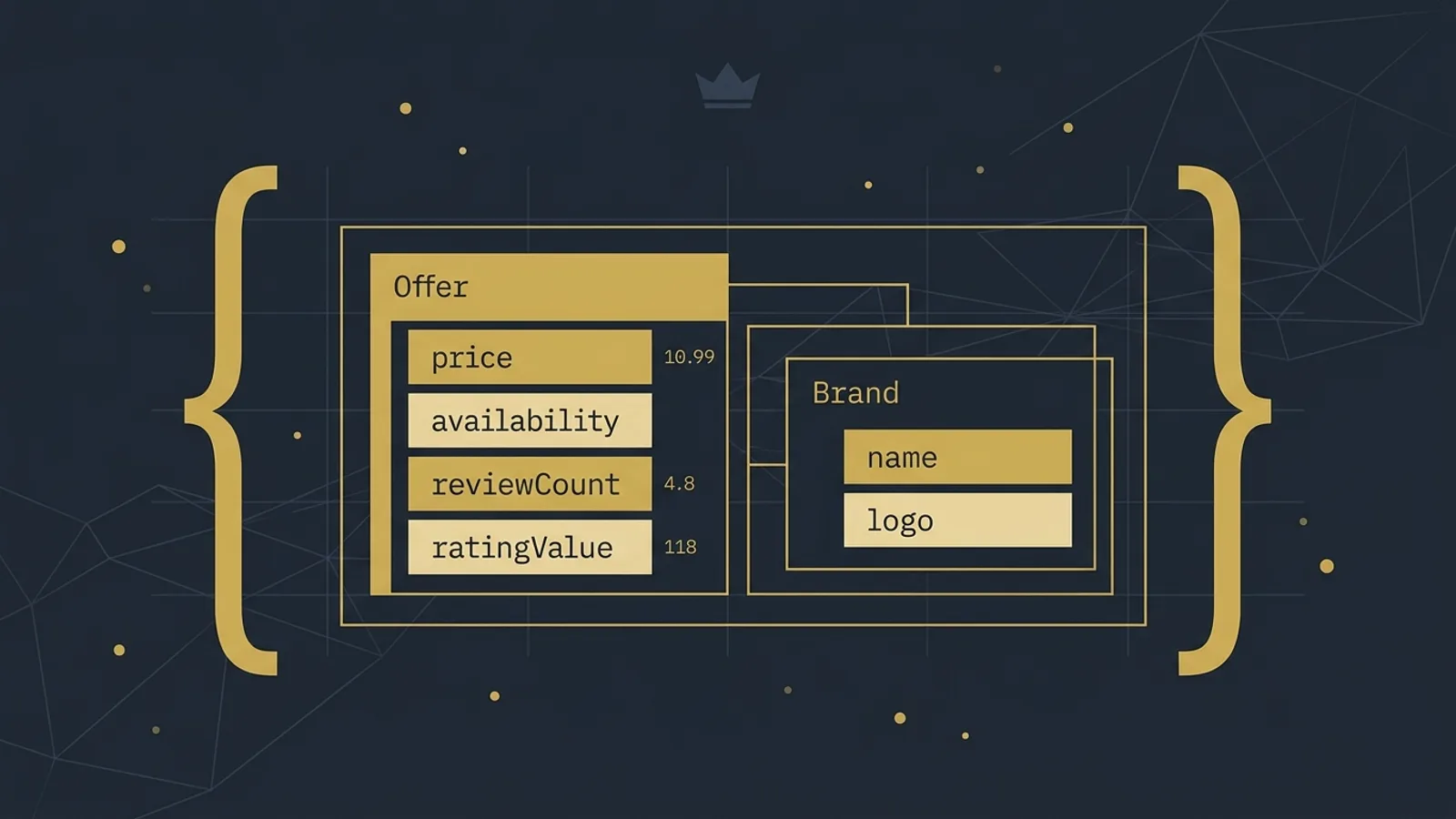
Product Schema Markup Optimization Steps
Follow this step-by-step process to implement product schema effectively. Each step builds on the previous one, creating a systematic approach that delivers consistent results.
Step 1: Audit and Baseline
Start by documenting your current product schema performance. Run a comprehensive site audit, record your current rankings for target keywords, and note your organic traffic levels. This baseline is essential for measuring progress.
Step 2: Keyword Research and Mapping
Identify the most valuable product schema opportunities through thorough keyword research. Use Rank Crown's Keywords Explorer to find terms with strong volume and achievable difficulty. Map each keyword to a specific page on your site.
Step 3: On-Page Optimization
Optimize your existing pages for their target product schema keywords. Update title tags, meta descriptions, heading structure, content depth, and internal links. Address any technical issues uncovered during the audit.
Step 4: Content Creation
Create new content to fill gaps in your product schema strategy. Focus on search intent - what does the user actually need when they search for this term? Build comprehensive resources that answer the query better than existing results.
Step 5: Link Building and Promotion
Develop and execute a link building strategy for your product schema content. Identify relevant linking opportunities through competitor analysis and outreach. Aim for quality over quantity - a few links from authoritative sites outperform dozens from low-quality sources.
Technical Setup for Product Schema Markup
Implementing product schema effectively requires a structured approach. Start with a thorough audit of your current state, identify the highest-impact opportunities, and create a prioritized action plan that delivers quick wins while building toward long-term gains.
Audit Your Current State
Before making changes, benchmark your existing product schema performance. Document current rankings, traffic levels, and technical health. This baseline data is essential for measuring the impact of your optimization efforts.
Prioritize High-Impact Actions
Not all product schema optimizations deliver equal results. Focus first on changes that are high impact and low effort: fixing technical errors, optimizing existing high-traffic pages, and targeting keywords where you rank on page 2 (positions 11-20).
Implement Systematically
Roll out product schema changes in phases, not all at once. This makes it easier to attribute ranking changes to specific actions and quickly roll back any changes that negatively impact performance.
Monitor and Adjust
After implementing product schema changes, monitor rankings, traffic, and user behavior closely for 2-4 weeks. Search engines need time to process changes, so avoid making additional modifications during this evaluation period.

Content Strategy for Product Schema Markup
A strong content strategy for product schema starts with understanding the types of content that perform well in your space. Analyze the top-ranking content for your target keywords to identify patterns in format, length, depth, and angle.
Build a content hub around your product schema topic cluster. Create a comprehensive pillar page that covers the broad topic, then link to and from supporting articles that dive deep into specific subtopics. This hub-and-spoke model signals topical authority to search engines and provides clear navigation paths for users.
Content freshness matters for product schema. Search engines favor recently updated content, especially for topics where information changes frequently. Schedule regular content audits to update statistics, refresh examples, and add new insights to your existing product schema content.
Key Takeaway
Your product schema content strategy should prioritize depth over breadth. It is better to thoroughly cover 20 topics with comprehensive, expert-level content than to superficially address 100 topics with thin, generic posts.
Common Product Schema Markup Mistakes
Even experienced professionals make mistakes with product schema. Being aware of these common pitfalls helps you avoid wasting time and resources on approaches that do not work or can actively harm your rankings.
Targeting Keywords That Are Too Competitive
New or small sites often target head terms with massive competition. Focus product schema efforts on long-tail keywords first, build authority, then gradually target more competitive terms.
Ignoring Search Intent
Creating content that does not match what users actually want when they search. Always analyze the current top-ranking pages for a keyword before creating your product schema content to understand what format and depth Google rewards.
Neglecting Technical SEO
Investing heavily in content while ignoring technical foundations. A slow, poorly-structured site with great content will always underperform a fast, well-structured site with good content.
Not Tracking Results
Many product schema practitioners fail to set up proper tracking from the start. Without baseline data and ongoing measurement, you cannot determine what is working or justify continued investment.

Measuring Product Schema Markup Success
Measuring the success of your product schema efforts requires tracking the right metrics at the right intervals. Focus on leading indicators (keyword rankings, impressions) alongside lagging indicators (traffic, conversions, revenue) to get a complete picture.
Set up a product schema dashboard that tracks these core metrics: organic sessions (overall and by landing page), keyword rankings for your target terms, click-through rates from search, conversion rates from organic traffic, and referring domain growth. Rank Crown provides all of these metrics in a single, unified dashboard.
Report on product schema performance monthly, but review data weekly to catch issues early. Look for trends rather than daily fluctuations - SEO metrics naturally vary day-to-day. A page that drops 2 positions on a Tuesday and recovers by Thursday is not a problem. A page that has been declining steadily for 4 weeks needs attention.
Pro Tip
Calculate the monetary value of your organic traffic by multiplying organic sessions by average conversion rate by average order value. This "traffic value" metric makes it easy to communicate product schema ROI to stakeholders and justify continued investment.
Related Resources
Ready to Improve Your Rankings?
Put these product schema strategies into action with Rank Crown. Get comprehensive keyword research, rank tracking, site auditing, and backlink analysis - everything you need to execute your SEO strategy effectively.
Frequently Asked Questions
What is product schema?
How long does product schema take to show results?
Is product schema worth the investment?
What are the most important product schema ranking factors?
How much does product schema cost?
Can I do product schema myself?
SEO Tool Comparison at a Glance
Choosing the right toolkit depends on your budget and the part of SEO you optimize most often. The table below summarizes how Rank Crown compares to the main alternatives covered across our resources.
| Tool | Starting Price | Free Plan | Best For |
|---|---|---|---|
| Rank Crown | $39/mo | Yes | Focused rank tracking + audits without bloat |
| Ahrefs | $129/mo | Limited | Backlink intelligence and large databases |
| Semrush | $139.95/mo | Limited | All-in-one for agencies combining SEO and PPC |
| Moz Pro | $99/mo | Limited | Beginner-friendly metrics like Domain Authority |
| SE Ranking | $65/mo | No | Budget-friendly tracking with white-label reports |
| Mangools | $29.90/mo | No | Lean keyword research workflow |
Prices verified 2026-05-20 from each vendor's public pricing page. Annual billing typically discounts these figures further.